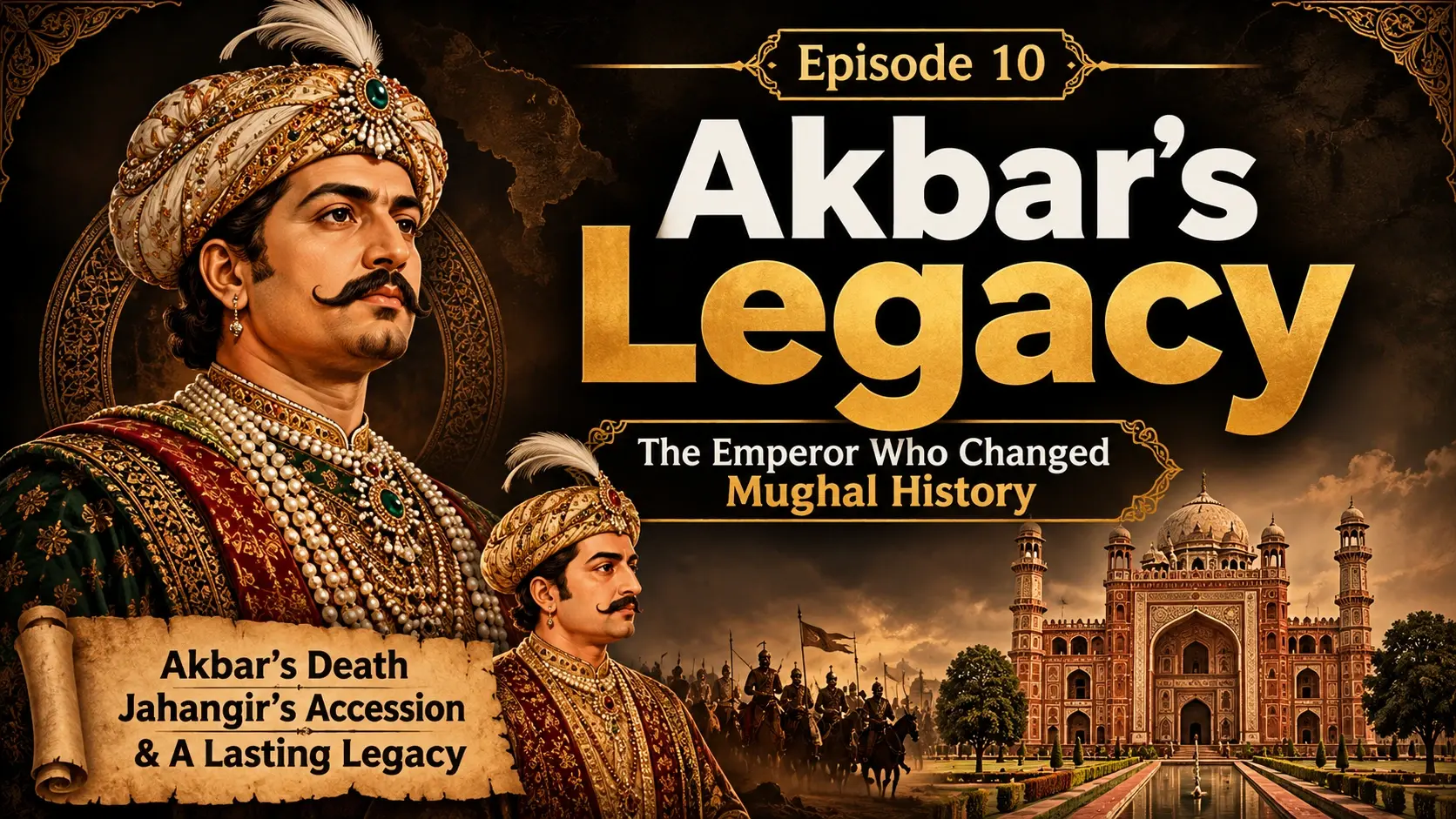
Akbar’s Legacy
Akbar’s Legacy: The End of a Remarkable Journey
An emperor who had conquered kingdoms, built powerful alliances, and ruled one of the greatest empires in Indian history was approaching the end of his journey. But what would happen to the empire he had spent his entire life building?
Akbar had used his military prowess, political acumen, and bold reforms to mould the Mughal Empire for almost fifty years. He had grown from a youthful monarch who took over an unstable realm to one of the most significant rulers in Indian history.Time, however, does not wait for an emperor. Akbar’s health started to deteriorate in 1605. The future of the royal palace, which had previously been the site of festivities and political debates, was now uncertain.His influence was only getting started, but his story was coming to an end.Akbar’s Legacy was not limited to military victories; his administration, religious tolerance, and cultural achievements helped shape the future of the Mughal Empire.
Akbar’s Death: The End of an Era
Akbar fell very unwell in the autumn of 1605. After overseeing a huge kingdom for many years, the emperor was now engaged in his last struggle with disease.The royal court grew more worried as his illness worsened. Officials, family members, and powerful nobles realised that the empire was about to lose its most powerful monarch.Akbar passed away in Agra on October 27, 1605, at the age of roughly sixty-three.His remarkable reign came to an end as word of his passing spread. A strong kingdom, a well-established government, and a convoluted royal family remained after the departure of the man who had revolutionised the Mughal Empire.His majestic tomb still exists as a memorial of his reign at Sikandra, close to Agra, which was eventually designated as his ultimate resting place.
Jahangir’s Accession: A New Emperor Rises
Prince Salim, Akbar’s eldest surviving son, inherited the Mughal throne following his death.In 1605, Salim assumed the royal title Jahangir, which translates to “Conqueror of the World,” and rose to become the fourth Mughal Emperor.For the empire, his accession was a significant event. After serving Akbar, the nobles and bureaucrats now had to accept a new king and get used to a new style of governance.Salim inherited the empire Akbar had worked so hard to build, despite the fact that he and his father had severe conflicts.Maintaining political stability and defending the Mughal throne’s power were Jahangir’s primary duties.The difficulties with succession did not, however, entirely go away. Prince Khusrau, his own son, would subsequently rebel against him, demonstrating the persistence of family strife in Mughal politics.Jahangir inherited an empire strengthened by Akbar’s Legacy, including its administrative structure and traditions of royal governance.Jahangir’s reign and achievements
Akbar’s Administrative Legacy
Akbar’s greatest accomplishments extended beyond the territories he subjugated. Additionally, he created mechanisms that improved the empire’s efficiency.The mansabdari system, which arranged government officials and military leaders based on ranks and duties, was one of his significant reforms.Under Raja Todar Mal’s direction, he also implemented significant revenue changes. The management and collection of land revenue were enhanced by these improvements.Persian-speaking officials and Rajput nobility were among the diverse group of persons under his administration. Akbar bolstered the empire and promoted intergroup collaboration by appointing gifted people to positions of authority.The Mughal emperors that came after him had a stronger base because to these systems.
Religious Tolerance and Cultural Development
Akbar’s Legacy thought that military might alone was insufficient for a diversified kingdom. It also required cooperation and understanding among its citizens.He cultivated contacts with communities and leaders of various faiths. Scholars, artists, poets, and philosophers who contributed to intellectual conversations were all welcome at his court.His well-known Ibadat Khana, or House of Worship, developed into a forum for philosophical and religious debates.In addition, Akbar encouraged literature, painting, architecture, and education. Mughal art and architecture created a unique style under his rule by fusing elements of several traditions.One of the most notable instances of his architectural aspirations is still Fatehpur Sikri, his magnificent imperial metropolis.Beyond the battlefield, his cultural interests and policies shaped the Mughal Empire’s identity.
Akbar’s Tomb: A Monument to His Legacy
Jahangir, Akbar’s son, was in charge of finishing his beautiful tomb at Sikandra after his death.The monument features stunning gateways, ornamental patterns, gardens, and striking structures that showcase a variety of architectural styles.The mausoleum, which stands in the serene environs of Sikandra, honours a monarch whose impact extended well beyond his reign.Even now, centuries later, tourists come to this monument to honour the monarch who changed the Mughal Empire.His tomb serves as more than just a last resting place. It is an enduring representation of his aspirations, accomplishments, and historical position.
http://<a href=Emperor Akbar’s life and achievements
Conclusion:
Akbar’s Legacy, and a New Beginning
Although Akbar’s voyage was dubious at first, his rule altered the Mughal Empire’s destiny.He enlarged its borders, bolstered its government, forged political connections, and promoted artistic accomplishments. His choices had an impact on the emperors who came after him as well as his own generation.When Jahangir took the throne in 1605, he inherited an empire that had been established over many years of hard work, triumphs, reforms, and tough choices.Although Akbar was no longer alive to lead his realm, his institutions and beliefs remained to influence Mughal governance.Although his reign was over, his legacy endured.And thus is the tale of Akbar the Great, the ruler who transformed an expanding kingdom into one of the strongest empires in Indian history.Even after his death, Akbar’s Legacy continued to influence Mughal rulers and remained an important part of Indian history.
All episodes of Babur to Akbar
-
1
 The Prince of Fergana
1 min read
In 1494 a twelve-year-old boy inherits a small kingdom and a world of enemies.
-
2
The Road to Panipat
1 min read
With guns, carts and a gamble, Babur meets the Sultan of Delhi on an April morning in 1526.
-
3
The Boy Emperor
1 min read
Crowned in a garden at thirteen, Akbar must win back an empire his father barely held.
-
4
A City of Red Sandstone
1 min read
Akbar builds a new capital on a ridge near Agra, and names it for victory.
-
5
The Nine Jewels
1 min read
A poet, a musician, a finance minister and a wit: the famous circle around Akbar.
-
6
 Akbar’s Ibadat Khana: A Remarkable Mughal History
2 min read
-
7
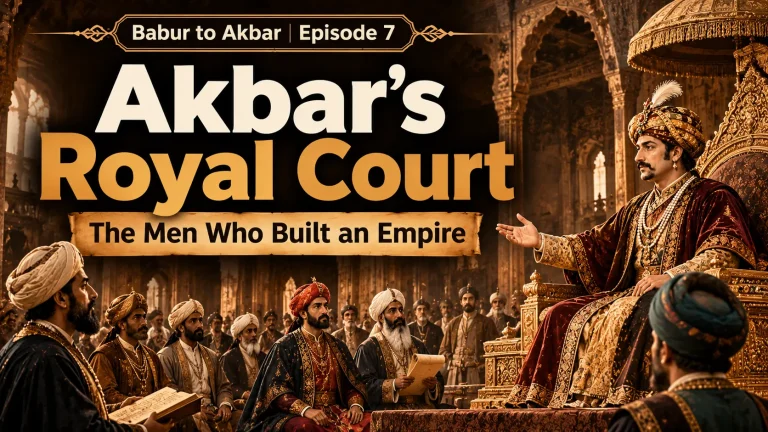
 Akbar’s Royal Court: The Men Who Built an Empire
4 min read
-
8
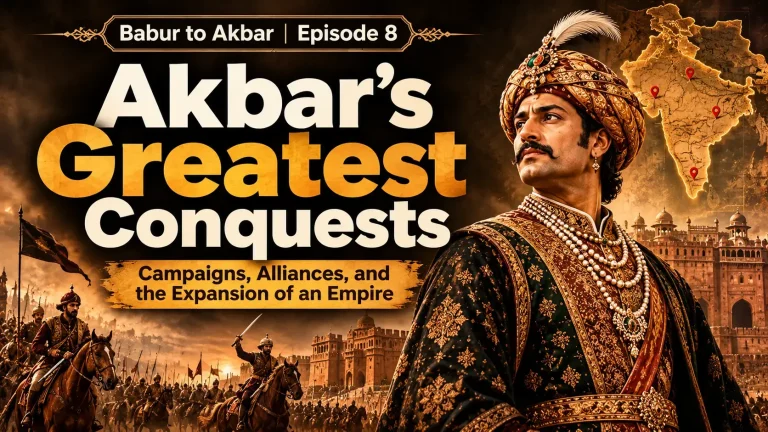
 Akbar’s Greatest Conquests
6 min read
-
10
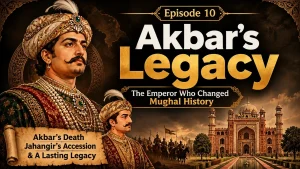 Episode 10: Akbar’s Legacy — The Emperor Who Changed Mughal History
5 min read