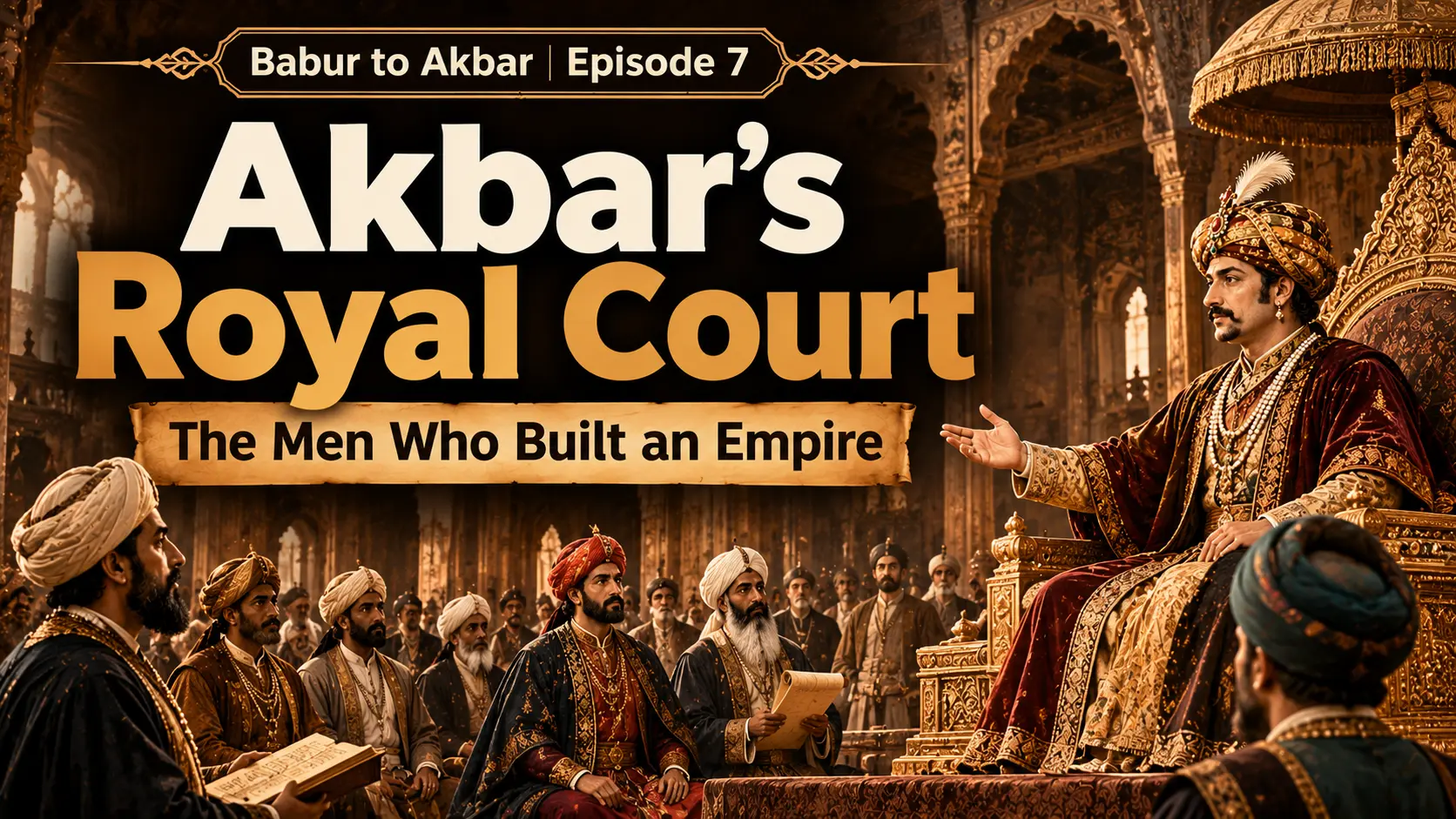
The Men Who Constructed an Empire: Akbar’s Royal Court
Imagine yourself outside the Fatehpur Sikri imperial palace. The walls made of red sandstone are illuminated by the morning sun. Horses traverse the royal grounds, couriers provide news from far-off provinces, while guards guard the entrance.Emperor Akbar is seated on his throne within. His dominion is expanding, but he must deal with a challenging issue: how can one monarch oversee such a large area?The solution is found in Akbar’s Royal Court, where skilled intellectuals, military leaders, and administrators assist him in creating a strong empire.
The Emperor Who Required More Than Just Soldiers
Nobles are waiting to greet the emperor as you enter Akbar’s Royal Court. While some oversee government affairs and resolve administrative issues, others command armies.Akbar is aware that an empire cannot be sustained by military triumphs alone. To oversee officials, soldiers, and far-off provinces, he requires a well-organized organisation.The mansabdari system is a key component of his administration. Officials are assigned ranks under this system, which dictate their status and duties. Many also serve in the armed forces.Akbar uses this technique to better structure his government and bolster his authority over the Mughal Empire.But money is needed to run a royal court and keep an army. Akbar requires a successful revenue mechanism for this. The Man Behind the Revenue System: Raja Todar MalImagine visiting a rural area where farmers toil in the bright sunlight on their fields. Their crops sustain the local economy and supply nourishment for their family.However, given that different regions have different harvests and land conditions, how can the government fairly collect land revenue?
A key player
in Akbar’s revenue management is Raja Todar Mal. He assists in setting up procedures for measuring land, evaluating agricultural output, and computing income.In key areas of the empire, these actions improve the systematisation of income collection.The funds raised go towards maintaining the government, paying officials, and funding the army.Farmers and administrators work tirelessly to maintain the empire behind the royal palace and its elaborate festivities.Abu’l-Fazl.
The Man Who Captured History
A scholar meticulously documents the monarch and his expanding kingdom back in Akbar’s Royal Court. One of Akbar’s key advisors and historians is named Abu’l-Fazl.The Akbarnama, a historical narrative of Akbar’s life and reign, is written by Abu’l-Fazl. The Ain-i-Akbari, its third volume, details court life, income arrangements, and the administration of the empire.We can comprehend how the Mughal government functioned thanks to his works.But since Abu’l-Fazl worked for Akbar, historians weigh his testimonies against other historical data to create a fair picture of the time.His writings are still a valuable resource for researching Mughal history.
An Empire of Distinct Communities
Akbar is in charge of individuals from many geographical areas, languages, and religious traditions. It takes political acumen and careful preparation to manage such a diverse people.People from a variety of backgrounds serve in his administration, including Rajput nobles who go on to become significant friends of the Mughal kingdom.His political position is strengthened by these connections. Disagreements and local disputes, however, keep undermining his power.Akbar progressively creates a system where military might, management, and relationships are all crucial.Maintaining relationships with the locals is just as important to his success as capturing new lands.
The Throne’s Quiet Power
The royal court starts to empty as night falls. Scribes continue to record information by lamplight, soldiers return to their jobs, while officials carry crucial instructions away.There is more to Akbar’s Royal Court than just an emperor sitting on a throne. It serves as the hub of a network that maintains historical records, manages revenue, supports the military, and links far-flung regions.Abu’l-Fazl documents the emperor’s history, Raja Todar Mal assists in setting up the income system, and other officials assist the government.These individuals work together to assist Akbar in running his growing empire.Akbar is aware that winning wars is not enough to establish an empire. It needs preparation, organisation, and people who can make his dreams come true.But as his dominion expands, he will face yet another obstacle.Can Akbar safeguard the empire he has laboriously built and increase his power even more?We will examine Akbar’s significant victories, political connections, and the campaigns that contributed to the Mughal Empire’s transformation in Episode 8 of Babur to Akbar.
Next episode coming on
All episodes of Babur to Akbar
-
1
 The Prince of Fergana
1 min read
In 1494 a twelve-year-old boy inherits a small kingdom and a world of enemies.
-
2
The Road to Panipat
1 min read
With guns, carts and a gamble, Babur meets the Sultan of Delhi on an April morning in 1526.
-
3
The Boy Emperor
1 min read
Crowned in a garden at thirteen, Akbar must win back an empire his father barely held.
-
4
A City of Red Sandstone
1 min read
Akbar builds a new capital on a ridge near Agra, and names it for victory.
-
5
The Nine Jewels
1 min read
A poet, a musician, a finance minister and a wit: the famous circle around Akbar.
-
6
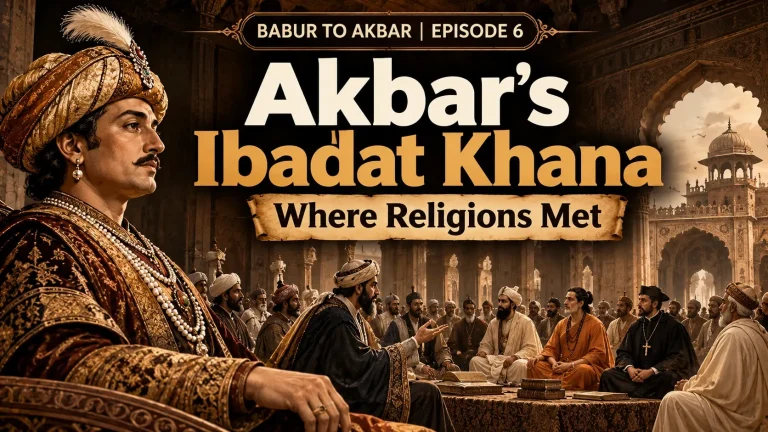
 Akbar’s Ibadat Khana: A Remarkable Mughal History
2 min read
-
7
 Akbar’s Royal Court: The Men Who Built an Empire
4 min read