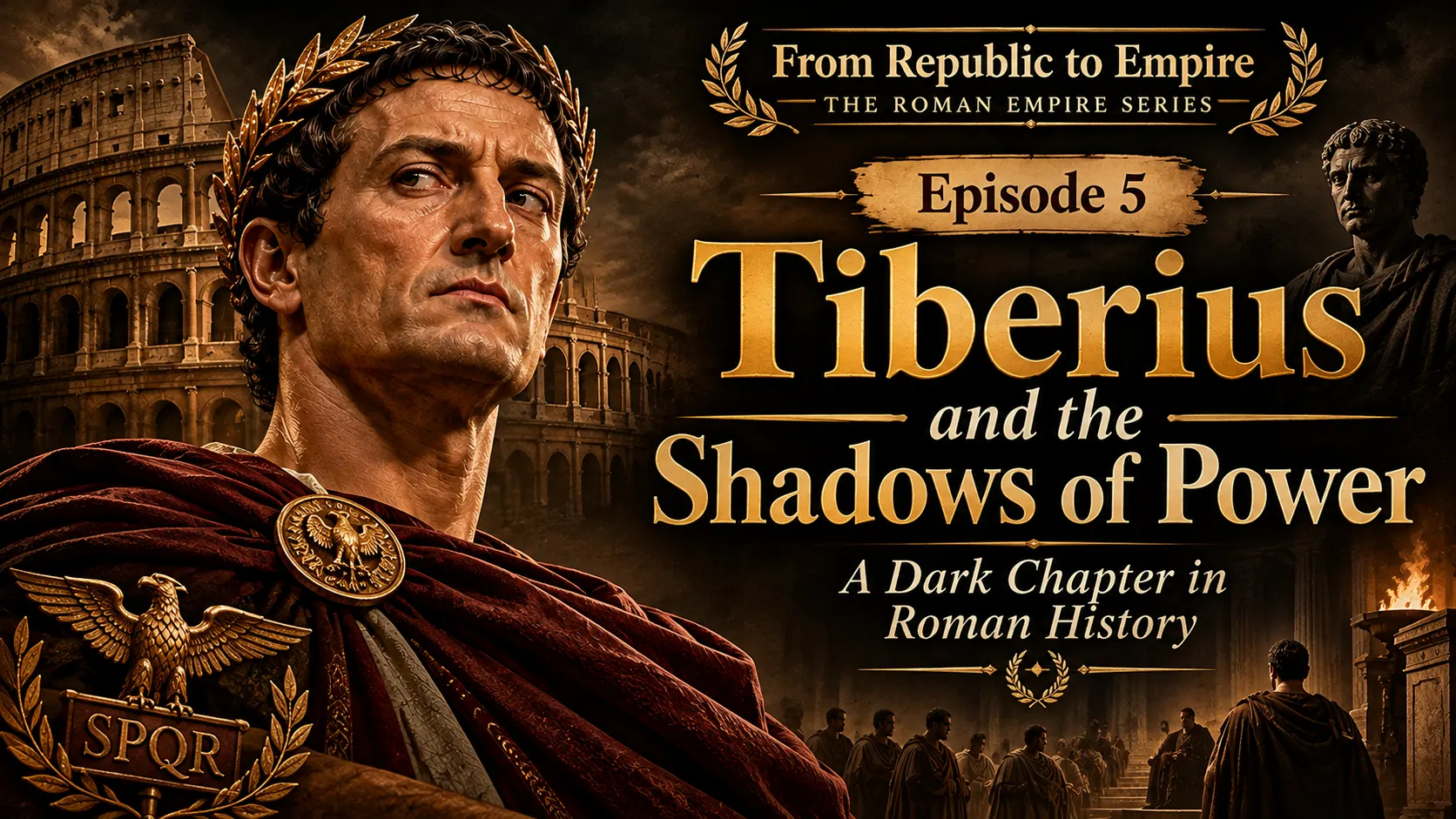
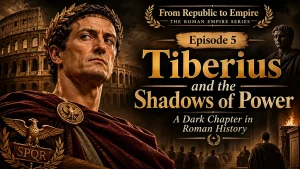
Episode 5: Tiberius Roman Emperor and the Shadows of Power.
Introduction
Tiberius roman emperor, A darker period in the Roman Empire’s history is revealed by the tale of Tiberius. Tiberius inherited a strong, prosperous, and comparatively stable empire after Augustus passed away in AD 14. But sustaining such stability turned out to be more challenging than anticipated. Rome’s environment was increasingly altered by political rivalry, mistrust, and treachery. Despite having the experience to rule the empire, Tiberius faced significant obstacles due to his relationship with the Senate and his increasing seclusion.
Tiberius Roman Emperor: The Challenge of Following Augustus
Tiberius roman emperor, In AD 14, Tiberius took up a challenging role as Rome’s second emperor. No one could be sure that Augustus’s political system, which was largely dependent on his own power, would function as effectively under a different ruler.
Tiberius was a seasoned administrator and military leader. throughout general, he followed Augustus’s policies, exercised fiscal restraint, and refrained from needless development throughout his early years as emperor. He struggled to gain the Senate’s trust, nevertheless, and lacked Augustus’s political flair.
His guarded demeanour made it hard for people to comprehend his goals, and his cautious nature occasionally gave the impression that he was weak. Although Augustus’s position had been passed down to the next emperor, the public’s affection for him had not.
Germanicus and the Growing Political Tension
Tiberius roman emperor, Germanicus, a well-liked Roman general and member of the imperial family, was a significant figure throughout Tiberius’s rule. Many Romans revered him because of his military prowess and public image.
Germanicus passed away in the eastern provinces in AD 19 under circumstances that raised a lot of suspicions. Although the precise circumstances are still up for debate, several questioned whether political rivalry had been involved.
His passing added to the unpredictability of Rome’s future leadership and heightened tensions within the imperial family. Germanicus’s popularity also brought to light a challenging issue for Tiberius: a successful emperor required both power and the trust of the Roman populace.
Sejanus: The Rise of a Dangerous Influence
Tiberius roman emperor, Tiberius trusted Lucius Aelius Sejanus, the Praetorian Guard commander, more as his dissatisfaction with Rome’s political system grew.
The emperor’s protection was the Guard’s duty, which gave its commander significant power. Sejanus became one of the most influential persons in Rome as he steadily increased his political influence.
But dread and uncertainty were brought on by his increasing power. Treason charges were levelled against political opponents, and the imperial court grew more polarised.
Tiberius roman emperor, Tiberius left Rome in AD 26 and made his home on the island of Capri. He continued to rule the empire after that, but Sejanus’s physical separation from the capital gave him even more sway over political matters.
An important turning point was the emperor’s retreat. Rome’s administration remained in place, but public life was increasingly clouded by political competition and suspicion.
The Fall of Sejanus
Although Sejanus seemed to be comfortable in his role, his authority was short-lived.
After realising that his aspirations endangered imperial power, Tiberius turned against him in AD 31. Tiberius condemned Sejanus in a message to the Senate, which then issued an order for his arrest and execution.
Rome was horrified by Sejanus’s abrupt demise. The individual who had amassed a great deal of power was now viewed as a traitor. His downfall showed that when they lost the emperor’s trust, even the most powerful officials were still at risk.
But faith was not instantly restored when Sejanus was removed. Roman society was still impacted by allegations of treason, and the political climate remained hostile.
The Final Years of Tiberius
Tiberius roman emperor, The majority of Tiberius’s last years were spent outside of Rome. He remained in power, but his reputation suffered due to his seclusion and the climate of political mistrust.
His leadership and character have been discussed by historians. While some versions highlight his administrative skills and the challenges he faced, others depict him as a brutal tyrant. Individual charges must be carefully considered because ancient sources were not always impartial.
Tiberius ruled for over twenty-three years before passing away in AD 37. Germanicus’ son Caligula succeeded him, and his ascent signalled the start of a new era in Roman imperial history. PBS — Tiberius, Roman Emperor
Conclusion
Tiberius’s rule revealed both the advantages and disadvantages of Augustus’ political structure. Personal rivalry, political anxiety, and the emperor’s retreat from Rome caused long-lasting issues, yet the empire survived its initial handover of power.
Although Tiberius had maintained the imperial system, his rule demonstrated that stability required more than just political power and military might. Rome faced a fresh dilemma as Caligula readied himself to assume power: would the succeeding emperor uphold Augustus’s heritage or steer the empire toward yet another uncertain era?
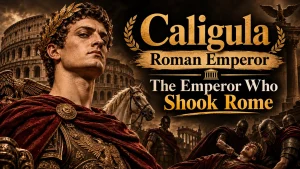
Find out what transpired when Caligula succeeded him as emperor of Rome by continuing the From Republic to Empire series.
All episodes of From Republic to Empire
-
1
 Crossing the Rubicon
1 min read
January 49 BC: a general reaches a small river and makes a choice there is no coming back from.
-
2
The Ides of March
1 min read
15 March 44 BC: the dictator for life walks into a meeting of the Senate.
-
3
Augustus, the First Emperor
1 min read
He never called himself king, yet he ruled Rome for forty years.
-
4
 Episode 4: The Pax Romana — How Augustus Built the Roman Empire
3 min read
-
5
 Episode 5:Tiberius Roman Emperor: The Dark Side of Power in Ancient Rome
5 min read
-
6
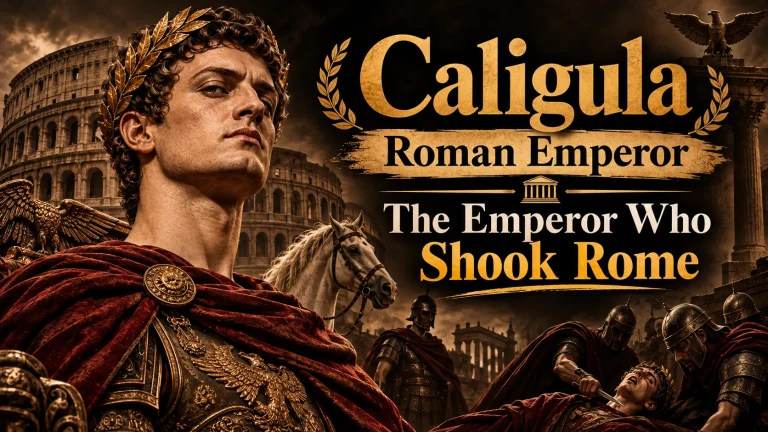
 Episode 6: Caligula Roman Emperor: The Emperor Who Shook Rome
4 min read