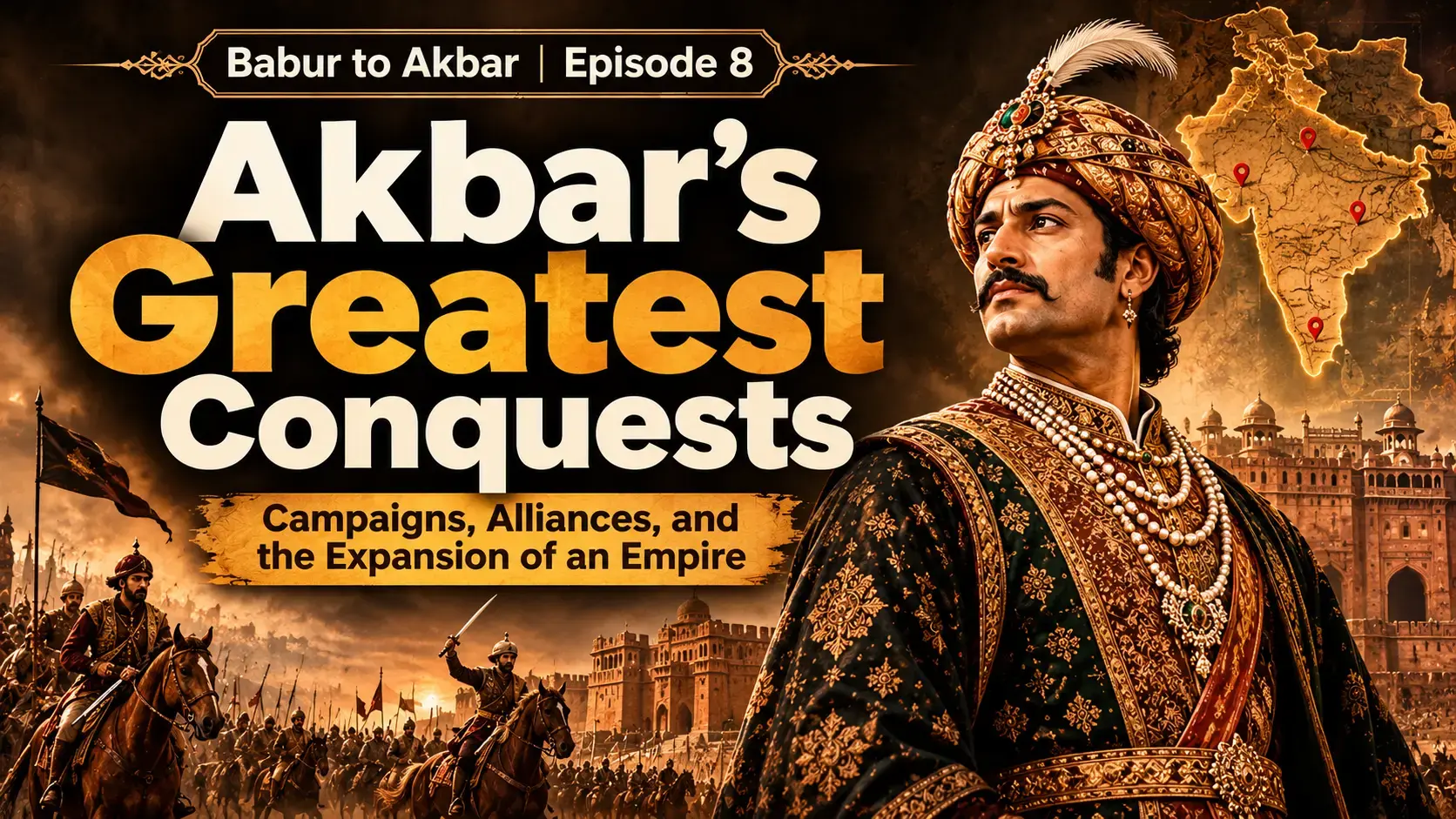
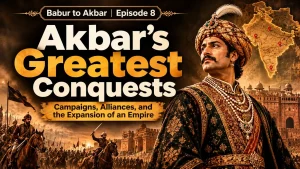
Akbar’s Greatest Conquests
How did a young emperor turn a fragile kingdom into one of the most powerful empires in Indian history?
When Akbar became Mughal emperor in 1556, his future was uncertain. Rival rulers challenged his authority, powerful kingdoms stood beyond his control, and his empire was far from secure. But Akbar had a vision that went beyond simply defending his throne. Through daring military campaigns, clever political alliances, and the support of powerful generals, he began expanding his empire across the Indian subcontinent. From the wealthy lands of Gujarat to the fertile plains of Bengal, every conquest brought new opportunities—and new enemies.Akbar’s Greatest Conquests played an important role in the expansion of the Mughal Empire. Through powerful military campaigns, strategic alliances, and important victories, Akbar expanded his kingdom and strengthened his position as one of the most influential emperors in Indian history.
This is the story of how Akbar’s Greatest Conquests, fought, negotiated, and conquered to build an empire that would shape history for generations.
When Akbar became Mughal emperor in 1556, his kingdom faced many challenges. Several regional rulers controlled their own territories, and powerful enemies threatened Mughal authority. Akbar wanted to build a strong empire that could survive for generations. He understood that winning battles was not enough. He needed political alliances, loyal generals, and an effective administration. Through military campaigns and diplomacy, Akbar gradually expanded the Mughal Empire across much of the Indian subcontinent.
The Second Battle of Panipat
Akbar’s Greatest Conquests journey toward expansion began with a major challenge. In 1556, Hemu, a powerful military commander, captured Delhi and challenged Mughal authority. Akbar’s army, led by Bairam Khan, confronted Hemu at the Second Battle of Panipat in November 1556. The Mughal forces won the battle and regained control of Delhi and Agra. This victory secured Akbar’s position and gave him the opportunity to strengthen his empire.
The Conquest of Malwa and Gujarat
In 1561, Akbar’s forces launched a campaign against Malwa, a strategically important region in central India. Mughal commanders defeated Baz Bahadur, the ruler of Malwa, and brought the region under Mughal control. A more significant campaign followed in Gujarat in 1572–1573. Gujarat was wealthy because of its commercial cities, ports, and international trade connections. Akbar personally led the campaign and captured important cities, including Ahmedabad. The conquest strengthened the Mughal economy and expanded imperial influence along India’s western coast.The conquest of Gujarat was one of Akbar’s Greatest Conquests because it gave the Mughal Empire control over important trade routes, wealthy cities, and valuable ports.
Rajput Alliances and the Battle of Haldighati
Akbar knew that cooperation could be as valuable as military victory. He formed alliances with several Rajput rulers, allowing them to serve in the Mughal administration and army. Raja Man Singh of Amber became one of Akbar’s most trusted commanders. These alliances helped Akbar strengthen his political influence and maintain control over different regions. However, not every Rajput ruler accepted Mughal authority. Maharana Pratap of Mewar continued to resist Akbar’s expansion. In 1576, Mughal forces led by Raja Man Singh fought Maharana Pratap’s army at the Battle of Haldighati. Although the Mughals gained the advantage, Maharana Pratap continued resisting Mughal control in the years that followed. This conflict showed that Akbar’s expansion sometimes required long struggles rather than quick victories.
The Conquest of Bengal
Bengal was another important region because of its fertile land, agricultural wealth, and trade connections. During the 1570s, Akbar’s forces campaigned against Afghan rulers who controlled the region. In 1576, Mughal forces defeated Daud Khan Karrani at the Battle of Rajmahal. This victory marked a major step in bringing Bengal under Mughal rule. Although resistance continued in some areas, Bengal became an important source of agricultural revenue and commercial wealth for the empire.
Kashmir, Sindh, and the Northwest
Akbar continued expanding his territories during the later years of his reign. Kashmir came under Mughal control in 1586, strengthening the empire’s position in the north. Mughal forces also expanded into Sindh during the late 1580s, gaining influence over important areas along the Indus River. These territories helped secure trade routes and strengthened Mughal authority across a wider region. However, controlling distant areas remained difficult and required continued military and administrative efforts.
The Deccan Campaigns
Akbar also wanted to expand Mughal influence into the Deccan, a large region of south-central India. In 1595, Mughal forces became involved in a conflict with the Ahmadnagar Sultanate. Chand Bibi, a prominent leader, organized resistance against the Mughal advance. In 1600, Mughal forces captured Ahmadnagar fort, marking an important achievement in Akbar’s southern campaigns. However, resistance continued, and the conquest of the Deccan remained unfinished when Akbar died in 1605. His successors would continue expanding Mughal influence in the region.
How Akbar Managed His Empire
Akbar’s success depended on more than military victories. He developed the mansabdari system, which organized officials and military commanders according to their ranks and responsibilities. He also appointed talented people from different backgrounds, including Rajput nobles and experienced administrators. These policies helped him govern a diverse empire and encouraged cooperation between the Mughal government and regional elites. Nevertheless, the expansion of the empire involved warfare, resistance, and considerable suffering. Akbar’s achievements came through both diplomacy and military force.
Conclusion
Akbar’s Greatest Conquests transformed the Mughal Empire into a powerful political force. His victories, alliances, and administrative reforms created an empire that influenced Indian history for generations.
By the end of Akbar’s reign in 1605, the Mughal Empire had grown significantly. His conquests of Gujarat, Bengal, Kashmir, and other territories increased its political and economic power. Through military campaigns, strategic alliances, and administrative reforms, Akbar transformed the Mughal Empire into one of the most influential powers in the Indian subcontinent. His greatest achievement was not simply conquering new lands but creating a stronger system of government to manage them.
To learn more about Akbar’s life and achievements, read his biography on <a href=”https://www.britannica.com/biography/Akbar” target=”_blank” rel=”noopener”>Encyclopaedia Britannica</a>.
In Episode 9, we will explore Akbar’s legacy and the cultural achievements that made his reign remarkable.
Next episode coming on
All episodes of Babur to Akbar
-
1
 The Prince of Fergana
1 min read
In 1494 a twelve-year-old boy inherits a small kingdom and a world of enemies.
-
2
The Road to Panipat
1 min read
With guns, carts and a gamble, Babur meets the Sultan of Delhi on an April morning in 1526.
-
3
The Boy Emperor
1 min read
Crowned in a garden at thirteen, Akbar must win back an empire his father barely held.
-
4
A City of Red Sandstone
1 min read
Akbar builds a new capital on a ridge near Agra, and names it for victory.
-
5
The Nine Jewels
1 min read
A poet, a musician, a finance minister and a wit: the famous circle around Akbar.
-
6
 Akbar’s Ibadat Khana: A Remarkable Mughal History
2 min read
-
7
 Akbar’s Royal Court: The Men Who Built an Empire
4 min read
-
8
 Akbar’s Greatest Conquests
6 min read