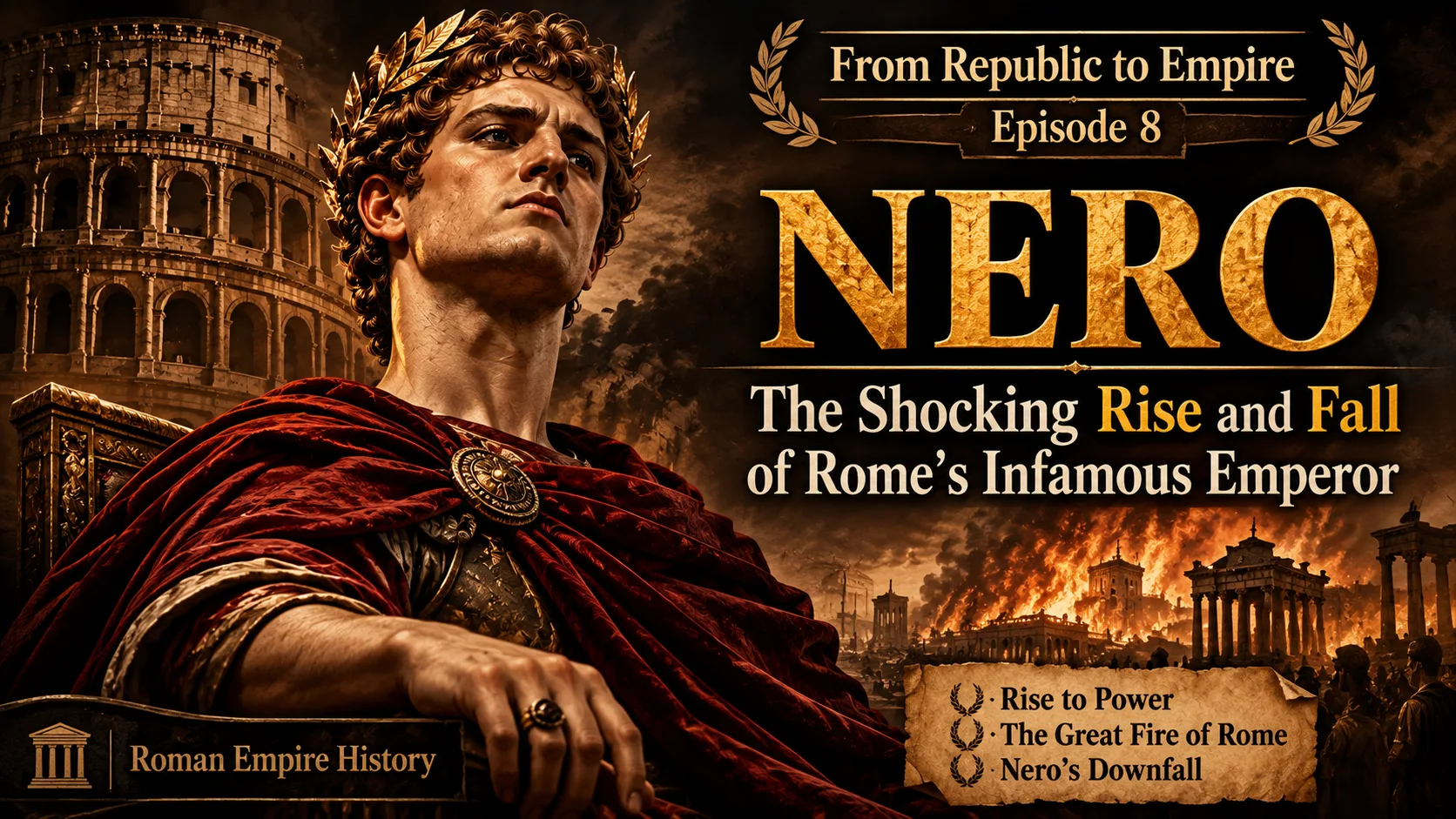
Episode 8: Nero – The Shocking Rise and Fall of Rome’s Infamous Emperor
Introduction
Emperor Nero, A new and dramatic chapter in Roman history began with the death of Claudius in AD 54. At the age of sixteen, Nero, his adoptive son, succeeded him as Roman emperor. Many Romans first believed that Nero would carry on Claudius’s successes and stabilise the empire. But in the end, his rule would be linked to personal ambition, political violence, and one of the worst catastrophes in Roman history.
The tale of Emperor Nero shows how a potential leader could turn into one of ancient Rome’s most divisive personalities.
The Rise of Nero to Power
Emperor Nero, After Claudius’s death in AD 54, Nero ascended to the throne. Agrippina the Younger, his mother, had been crucial in securing his succession.
Nero greatly depended on seasoned advisors in the early years of his rule, such as the Praetorian Prefect Burrus and the philosopher Seneca. A comparatively stable government was established thanks to their leadership.
At first, Nero expressed interest in entertainment, public administration, and strengthening ties with the Roman Senate. Many Romans responded well to his early policies.
But with time, his relationship with Agrippina grew more challenging. Nero desired to govern on his own instead of continuing to be influenced by his mother as he became more self-assured.
Political Conflicts and Family Betrayal
Emperor Nero, Nero’s complex connection with his family was one of the most dramatic features of his rule.
Nero progressively drove Agrippina away from political power, despite her expectations that she would continue to have a significant influence over her son. Eventually, their disagreement turned really serious.
Ancient historical texts state that Nero ordered the death of Agrippina in AD 59. Her passing stunned Roman society and exposed the emperor’s increasingly brutal reign.
Nero also got embroiled in disputes with the political establishment and members of the imperial family. His acts undermined confidence in imperial leadership and instilled terror in senators. The Roman Empire: Nero – PBS
The Great Fire of Rome
Emperor Nero, The Great Fire of Rome in AD 64 was one of the most well-known incidents that occurred under Nero’s rule.
Large portions of Rome were destroyed by the fire, which started in the city and lasted for several days. Important structures and temples were either totally destroyed or severely damaged, and many of locals lost their homes.
Although Nero was later accused of lighting the fire in ancient tales, historians have not discovered any solid proof that he did so on purpose.
Nero presented ideas for rebuilding portions of the city and coordinated relief efforts for individuals impacted. However, his reputation was harmed by rumours that he was responsible for the catastrophe.
After the fire, Nero also started building the Domus Aurea, or Golden House, a massive palace complex that came to represent imperial opulence.
Nero’s Persecution and Growing Unpopularity
Emperor Nero, Nero encountered increasing political opposition and criticism following the Great Fire.
According to the ancient historian Tacitus, Nero punished certain Christians severely and held them responsible for the catastrophe. These incidents are frequently cited as an early instance of Christian persecution during the Roman Empire.
At the same time, traditional Roman elites disapproved of Nero’s passion for acting, music, and public shows because they thought these pursuits were inappropriate for an emperor.
His standing among influential members of Roman society was severely damaged by his growing luxury and political choices.
The Fall and Death of Nero
Emperor Nero, Nero had to deal with uprisings throughout the empire by AD 68. Galba, the governor of Hispania, became a significant opponent, and a number of military chiefs withdrew their support.
Eventually, the Senate designated Nero as a public enemy, depriving him any dependable military or political backing.
Nero left Rome after failing to regain his position of power. At the age of thirty, he committed suicide in June of AD 68.
The Julio-Claudian dynasty, which had governed Rome since Augustus’ time, came to an end with his death.
Conclusion
Emperor Nero, One of the most spectacular eras in Roman imperial history is the reign of Emperor Nero. Despite the promise of his early reign, his position was ultimately shattered by political disputes, familial betrayals, and mounting opposition.
The Julio-Claudian dynasty came to an end with his death in AD 68, and Rome entered the Year of the Four Emperors, another unstable time.
However, Rome’s imperial conflicts continued after Nero’s downfall. There was a fresh struggle for the throne, and a number of strong individuals were getting ready to take over the empire.
Continue the From Republic to Empire series to discover how Rome entered the Year of the Four Emperors and witnessed another dramatic struggle for power.
All episodes of From Republic to Empire
-
1
 Crossing the Rubicon
1 min read
January 49 BC: a general reaches a small river and makes a choice there is no coming back from.
-
2
The Ides of March
1 min read
15 March 44 BC: the dictator for life walks into a meeting of the Senate.
-
3
Augustus, the First Emperor
1 min read
He never called himself king, yet he ruled Rome for forty years.
-
4
 Episode 4: The Pax Romana — How Augustus Built the Roman Empire
3 min read
-
5
 Episode 5:Tiberius Roman Emperor: The Dark Side of Power in Ancient Rome
5 min read
-
6
 Episode 6: Caligula Roman Emperor: The Emperor Who Shook Rome
4 min read
-
7
 Episode 7: Claudius – The Unexpected Emperor Who Changed Rome
4 min read
-
8
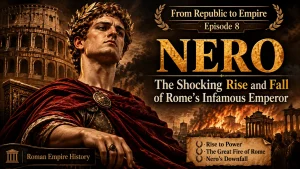 Episode 8 : Nero – The Shocking Rise and Fall of Rome’s Infamous Emperor
5 min read
-
9
 Episode 9: The Year of the Four Emperors – Rome’s Shocking Battle for Power
4 min read
-
10
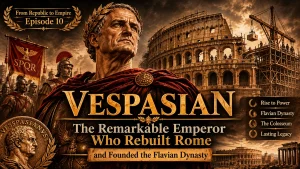 Episode 10:Vespasian Emperor: The Remarkable Emperor Who Rebuilt Rome and Founded the Flavian Dynasty
5 min read