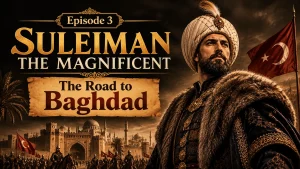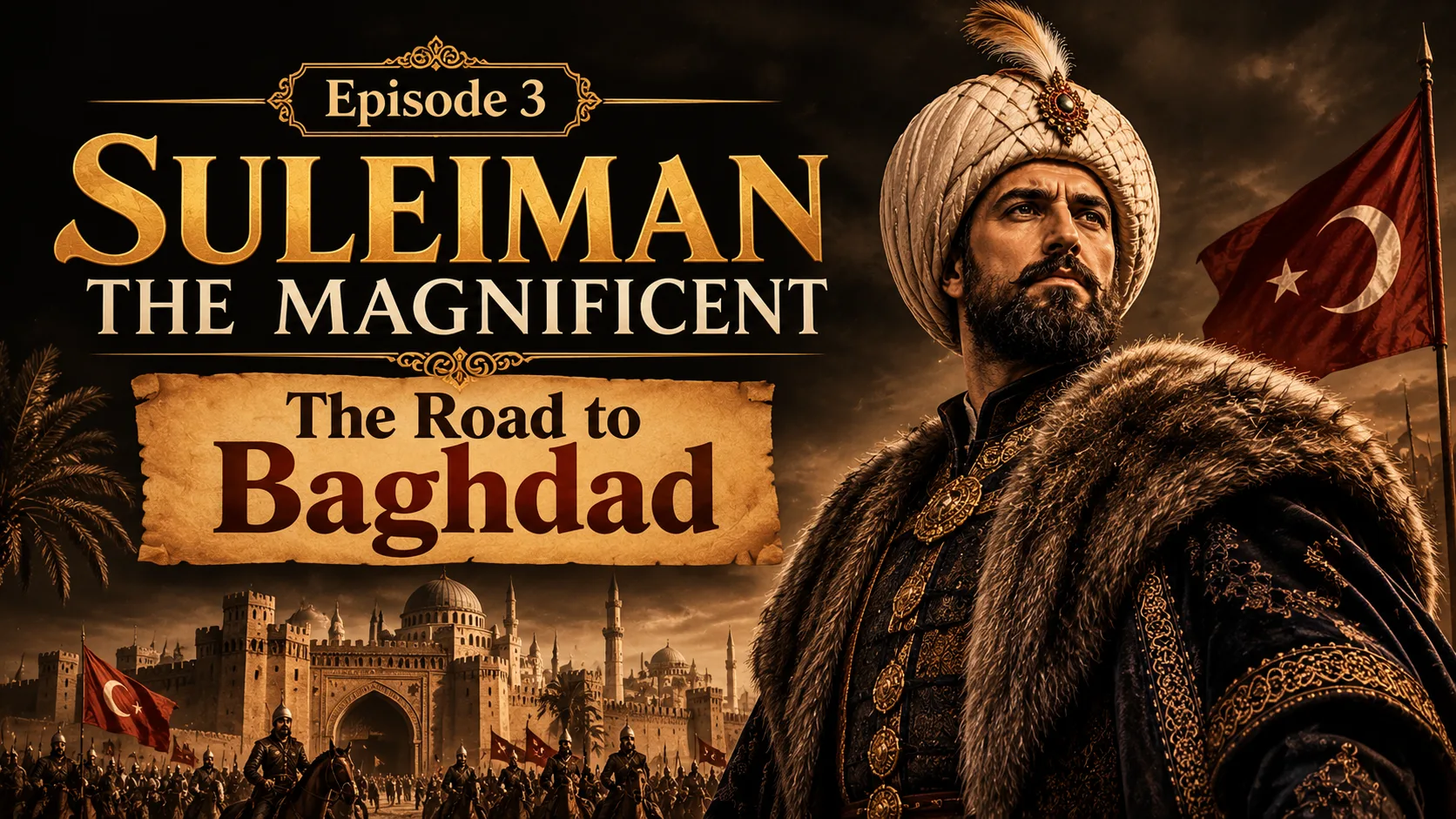
Episode 3:The Road to Baghdad – Suleiman the Magnificent
Introduction
Suleiman the Magnificent was a leader who did not consider failure to be the end of his dreams. His focus progressively turned eastward following his failed battle against Vienna in 1529. The Safavid Empire of Persia, a formidable adversary, was waiting there. Shah Tahmasp, its king, contested Ottoman control over significant Middle Eastern lands.
This was more than just a land dispute for Suleiman. It was a struggle for control over some of the most significant cities in the Islamic world, commercial routes, and political clout. He would go toward Baghdad in his next campaign.
Suleiman the Magnificent and the Safavid Rivalry
Suleiman the magnificent, There was a long history of religious and political enmity between the Ottoman and Safavid dynasties. Sunni Islam was practiced by the Ottoman ruling class, whereas Shia Islam was practiced by the Safavids. But land, strength, and regional influence also played a role in their battle.
Shah Tahmasp sought to stop Ottoman expansion of his dominion. Suleiman’s goal was to increase Ottoman authority over Iraq, eastern Anatolia, and the neighbouring areas.
As both empires fought for vital trade routes and strategic cities, the competition grew more intense. Suleiman understood that his empire’s stability may be jeopardised if the eastern borders were left unguarded.
The Campaign of 1533–1534
Suleiman the magnificent, Under Grand Vizier Ibrahim Pasha, Ottoman armies launched a significant eastern campaign in 1533. Suleiman himself joined the military expedition the next year.
The Ottoman army advanced on the Safavid lands, which included Tabriz, a significant hub for trade and politics. Shah Tahmasp, however, managed to avoid a significant frontal conflict. Instead, the Ottoman army found it challenging to obtain supplies as Safavid forces retreated and employed scorched-earth tactics.
Suleiman persisted in his march in spite of these obstacles. His tenacity demonstrated that his aspirations had not been diminished by the setback in Vienna. His current priorities were strengthening Ottoman power and defending the eastern frontier.
The Conquest of Baghdad in 1534
Suleiman the magnificent, The conquest of Baghdad in December 1534 was one of the campaign’s greatest successes.
Baghdad was an ancient city of great religious, cultural, and commercial significance. It continued to be a significant symbol of authority in the area and had formerly served as the capital of the Abbasid Caliphate.
Suleiman’s invasion of Baghdad gave the Ottomans control over a strategically important city and improved their standing in Iraq. This triumph was more than just another military triumph. Additionally, it made the Ottoman Empire more significant both politically and economically.
Suleiman presented himself as a guardian of the city’s historical and cultural legacy while touring significant religious locations.
A Victory That Changed the Empire
Ottoman power in the Middle East was bolstered by the conquest of Baghdad. It improved the empire’s access to vital commercial routes and strengthened its hold on the eastern boundary.
The battle with the Safavids did not, however, stop entirely. Tensions persisted for several years, and Shah Tahmasp remained a significant adversary.
Additionally, the campaign proved Suleiman’s capacity to command military operations in many geographical areas. His aspirations extended beyond the expansion of Europe. He desired an empire strong enough to have an impact on both Asia and Europe.Read Suleiman the Magnificent – World History Encyclopedia
Conclusion
Another significant period in Suleiman the Magnificent’s life was the Road to Baghdad. His eastern expedition resulted in a major success, despite Vienna’s resistance to his approach.
Suleiman’s influence spread throughout the Middle East after the Ottoman Empire gained control of Baghdad in 1534.
However, his tale was far from finished. There were still ambitious campaigns, strong competitors, and new obstacles to overcome. Long after his rule ended, Suleiman’s dominion would continue to have an impact.
Next episode coming on