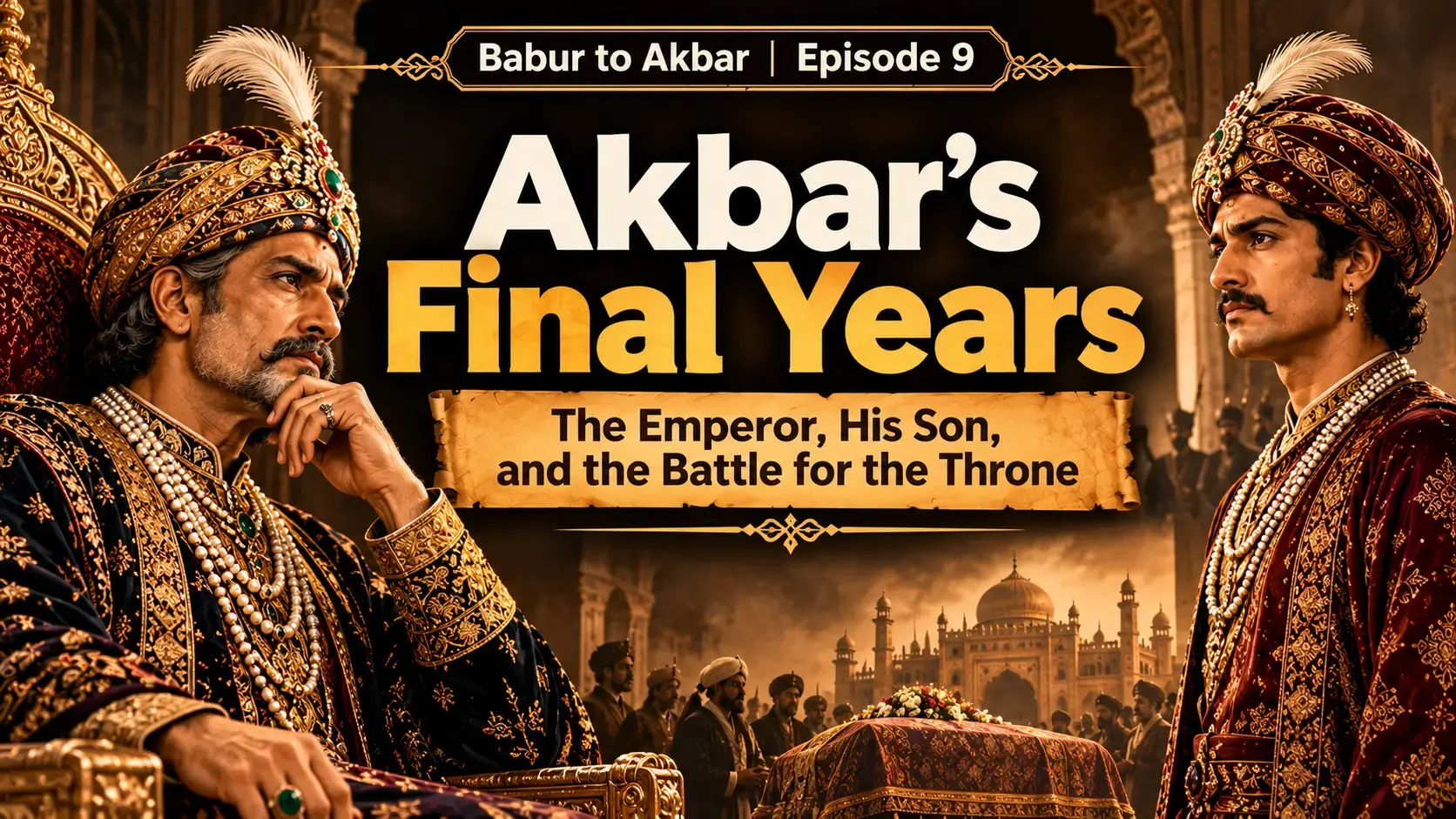
Episode 9: Akbar’s Final Years
Introduction:
Akbar’s Final Years: The Emperor’s Greatest Challenge
Akbar had conquered kingdoms, defeated powerful rivals, and built one of the greatest empires in Indian history. But as he grew older, a new challenge emerged—one that no army could easily defeat. Who would inherit his empire after his death?
Family disputes, political difficulties, and doubts about the Mughal Empire’s future characterised Akbar’s final years. Even though he had established a strong kingdom, one of the hardest choices he had to make throughout his rule was selecting the best successor.
Akbar had controlled the Mughal Empire for over forty years by the late 1590s. His administration was strong, his court was prosperous, and his influence was felt throughout most of the Indian subcontinent. But beneath the opulence of his castle, there was a great deal of stress about the succession issue.His sons had their own goals, his nobles had their own allegiances, and the empire’s destiny was still up in the air.
Prince Salim: A Son Who Wanted the Throne
There was significant tension within the royal family during Akbar’s final years due to the escalating disagreement between Emperor Akbar and Prince Salim. Their dispute over succession and authority put the Mughal Empire’s stability in jeopardy.Prince Salim, the oldest surviving son of Akbar, thought he was the rightful heir to the Mughal empire. But the father and son’s relationship grew more tense.Salim desired more autonomy and political power, whereas Akbar expected his son to submit. Their arguments became increasingly heated as the emperor grew older.
In 1599, Salim launched an uprising and established his own base of authority at Allahabad while Akbar was busy with battles in the Deccan. He defied the authority of the emperor who had established the empire he aspired to inherit by acting independently of his father.
This was an agonising issue for Akbar. Protecting the empire was his top priority, but there was strife among his own family.
The Tragedy of Abu’l-Fazl
Abu’l-Fazl, a renowned scholar, historian, and imperial advisor, was among Akbar’s closest associates. He supported many of the emperor’s political beliefs and contributed to the documentation of Akbar’s rule.
Salim saw Abu’l-Fazl as a hindrance to his goals. While returning to Akbar’s court in 1602, Abu’l-Fazl was killed. Salim planned the assault, and Bundela leader Bir Singh Deo executed the plan.
Akbar was profoundly saddened by the loss. Abu’l-Fazl was more than just an official; he was a loyal friend of the emperor and a significant voice in his government.
The conflict between Akbar and Salim was made even more agonising by the murder. It also became clear how serious the power battle had gotten.
Akbar’s Family Faces More Losses
Akbar’s last years were even more disappointing. Salim was his only surviving son after his sons Murad and Daniyal passed away before him.
The deaths reduced Akbar’s alternatives and increased the urgency of the succession issue. Salim’s eldest son, Prince Khusrau, was also supported by powerful nobility.
Khusrau was viewed by several nobility as a potential replacement for his father. Salim was seen by others as having the best claim to the throne.
It was no longer only a question of family ties. It concerned which option would prevent unrest in the empire following Akbar’s demise.
Akbar’s Final Days
Akbar’s health had deteriorated significantly by October 1605. The emperor was nearing the end of his life after decades of commanding troops and overseeing a sizable empire.
Strong aristocrats at court weighed the effects of various succession decisions. Political unpredictability resulted from support for Salim and Khusrau, and a struggle for the throne continued to be a serious issue.
Historical narratives state that Akbar and Salim eventually made amends. He acknowledged Salim as his heir near the end of his life, which helped avert an impending full-scale conflict for the throne.
Akbar’s rule, which had revolutionised the Mughal Empire, came to an end with his death in October 1605.
Jahangir: The Next Mughal Emperor
Salim took the throne upon Akbar’s demise and took on the royal title **Jahangir**, which translates to “Conqueror of the World.”
The change was a pivotal point in Mughal history. Jahangir inherited a formidable empire backed by a well-established government, seasoned nobility, and a robust imperial heritage.
Tensions among the family did not entirely go away, either. Jahangir would eventually encounter difficulties with his own son, Khusrau, demonstrating that Mughal emperors continued to struggle with succession.
Although Akbar had established an empire that would last long after his death, he was unable to completely maintain the unity of the royal family.Akbar’s Biography – Britannica
Conclusion: The End of an Era
The human aspect of a strong monarch was exposed during Akbar’s last years. Although his accomplishments had strengthened the Mughal Empire, his last days were uncertain due to disputes within his own family.
His narrative encompassed more than just political reforms, money, and victories. In addition, it dealt with ambition, trust, family strife, and the challenging issue of who should take the throne next.
One amazing period of Mughal history came to an end with Akbar’s death in 1605. Jahangir inherited both the throne and the heavy burden of upholding his father’s legacy.Akbar’s Final Years marked the end of a remarkable chapter in Mughal history. His death in 1605 brought Jahangir to the throne and began a new chapter in the history of the Mughal Empire.
In Episode 10, we will explore Akbar’s lasting legacy and discover how his decisions shaped the Mughal Empire for generations.
All episodes of Babur to Akbar
-
1
 The Prince of Fergana
1 min read
In 1494 a twelve-year-old boy inherits a small kingdom and a world of enemies.
-
2
The Road to Panipat
1 min read
With guns, carts and a gamble, Babur meets the Sultan of Delhi on an April morning in 1526.
-
3
The Boy Emperor
1 min read
Crowned in a garden at thirteen, Akbar must win back an empire his father barely held.
-
4
A City of Red Sandstone
1 min read
Akbar builds a new capital on a ridge near Agra, and names it for victory.
-
5
The Nine Jewels
1 min read
A poet, a musician, a finance minister and a wit: the famous circle around Akbar.
-
6
 Akbar’s Ibadat Khana: A Remarkable Mughal History
2 min read
-
7
 Akbar’s Royal Court: The Men Who Built an Empire
4 min read
-
8
 Akbar’s Greatest Conquests
6 min read
-
9
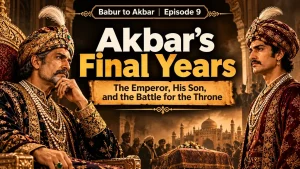 Episode 9: Akbar’s Final Years; The Emperor, His Son, and the Throne Struggle
5 min read
-
10
 Episode 10: Akbar’s Legacy — The Emperor Who Changed Mughal History
5 min read