History of Gobekli Tepe:
Introduction
One of the most intriguing accounts of prehistoric human civilisation is the History of Gobekli Tepe. Gobekli Tepe is a remarkable archaeological site that altered our knowledge of early human history. It is situated in south-east Turkey, close to the city of Şanlıurfa. Constructed circa 9600 BCE, this enigmatic location is said to be among the world’s oldest massive religious buildings. It predates both Stonehenge and the Egyptian pyramids by thousands of years.
The fact that Gobekli Tepe was built by hunter-gatherer societies prior to the emergence of agriculture and permanent towns is what makes it so amazing. The conventional wisdom that people invented farming, constructed villages, and then erected religious monuments was called into question by its discovery. Rather, Gobekli Tepe contends that religious activities and common beliefs may have been crucial in uniting early societies.
History of Gobekli Tepe and Its Ancient Origins
The Gobekli Tepe tale starts about 11,600 years ago, during the Pre-Pottery Neolithic period. Hunting wild animals and harvesting vegetables, fruits, and seeds were the primary means of subsistence for humans at that time. They lacked sophisticated construction technology, contemporary machinery, and tools. They could, however, organise sizable groups and build striking stone constructions.
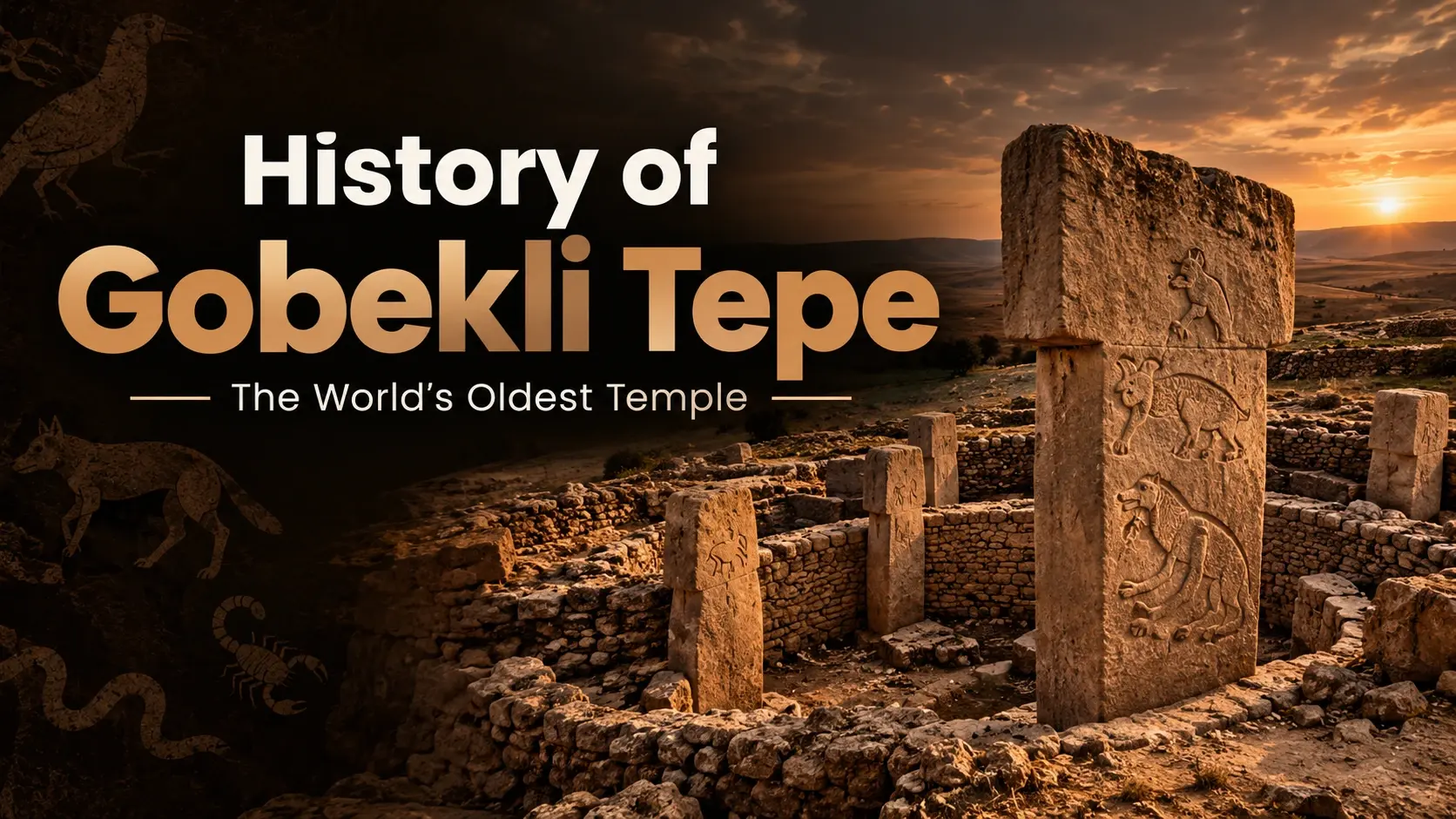
The location has a number of oval and round enclosures supported by enormous limestone pillars. Some of these pillars are several metres tall, and many of them have the shape of the letter T. According to archaeologists, prehistoric societies used basic tools and human muscle to move and arrange these massive stones.
The intricate carvings on Gobekli Tepe’s pillars made its history much more fascinating. Animals including foxes, snakes, wild boars, birds, and scorpions are depicted in these carvings. Additionally, some pillars have human-like shapes and abstract symbols. These artistic elements imply that the site’s builders had a strong bond with nature and a complex symbolic culture.
The enclosures may have been utilised for religious activities, ceremonies, or get-togethers, according to archaeologists. The stunning building demonstrates that early people were remarkably creative, cooperative, and organised, even though their precise function is still unknown.
Discovery of Gobekli Tepe and Its Archaeological Importance
Gobekli Tepe received international archaeological attention in 1963 after experts studied the area, despite the fact that local residents were aware of the ancient hill. But when German archaeologist Klaus Schmidt started methodical excavations in 1994, its actual significance became apparent.
The findings fundamentally altered our knowledge of prehistoric communities in archaeology. Massive stone pillars, thoughtfully constructed enclosures, animal sculptures, and proof of organised human activity were discovered by researchers. These results showed that long before regular farming societies emerged, hunter-gatherers were capable of building massive structures.
The evidence of widespread cooperation in Gobekli Tepe’s history is among its most unexpected features. It took a lot of preparation, cooperation, and work to move and shape massive limestone pillars. This implies that archaic societies were far more structured than previously thought.
In recognition of History Of Gobekli Tepe’s exceptional significance to human history, UNESCO formally placed it to the World Heritage List in 2018. It is now regarded as one of the most important modern-day archaeological findings.
History of Gobekli Tepe, Its Mystery and Legacy
Many of the mysteries surrounding Gobekli Tepe are still unresolved despite decades of enquiry. Why its ancient architects eventually covered the enormous structures with dirt and abandoned them is one of the most important questions. Certain enclosures may have been purposefully buried in prehistoric times, according to archaeological data.
The precise rationale behind this choice is still up for debate, though.
The reason behind the animal engravings is another mystery. According to some experts, these pictures depicted stories associated with ancient customs, spiritual beliefs, or protective symbols. Others contend that the buildings served as significant gathering spots for social events and ceremonies between various cultures.
Explore the History of Hattusa to discover another fascinating ancient civilization.
Important information about the shift from hunting and gathering to settled agriculture may also be found on the website. The surrounding area was more complicated than previously thought, according to evidence of household structures. History Of Gobekli Tepe was not your typical hamlet, yet it did exist at a time when human society was undergoing significant transformation.
Historians, archaeologists, scholars, and tourists from all over the world are still drawn to the History of Gobekli Tepe today. A unique link to individuals who lived thousands of years before written history is provided by its striking stone pillars and enigmatic carvings.
History of Gobekli Tepe serves as a reminder that prehistoric people were creative, intellectual, and capable of remarkable feats. It shows that human cooperation, architecture, and spiritual traditions evolved far earlier than previously thought, challenging long-held beliefs about civilization.
History Of Gobekli Tepe is an amazing insight into the beginnings of human civilization, not only a historic archaeological site. It is one of the most significant prehistoric sites ever found, and its discoveries continue to alter our perception of the past.
Explore more about ancient civilizations and archaeological discoveries.