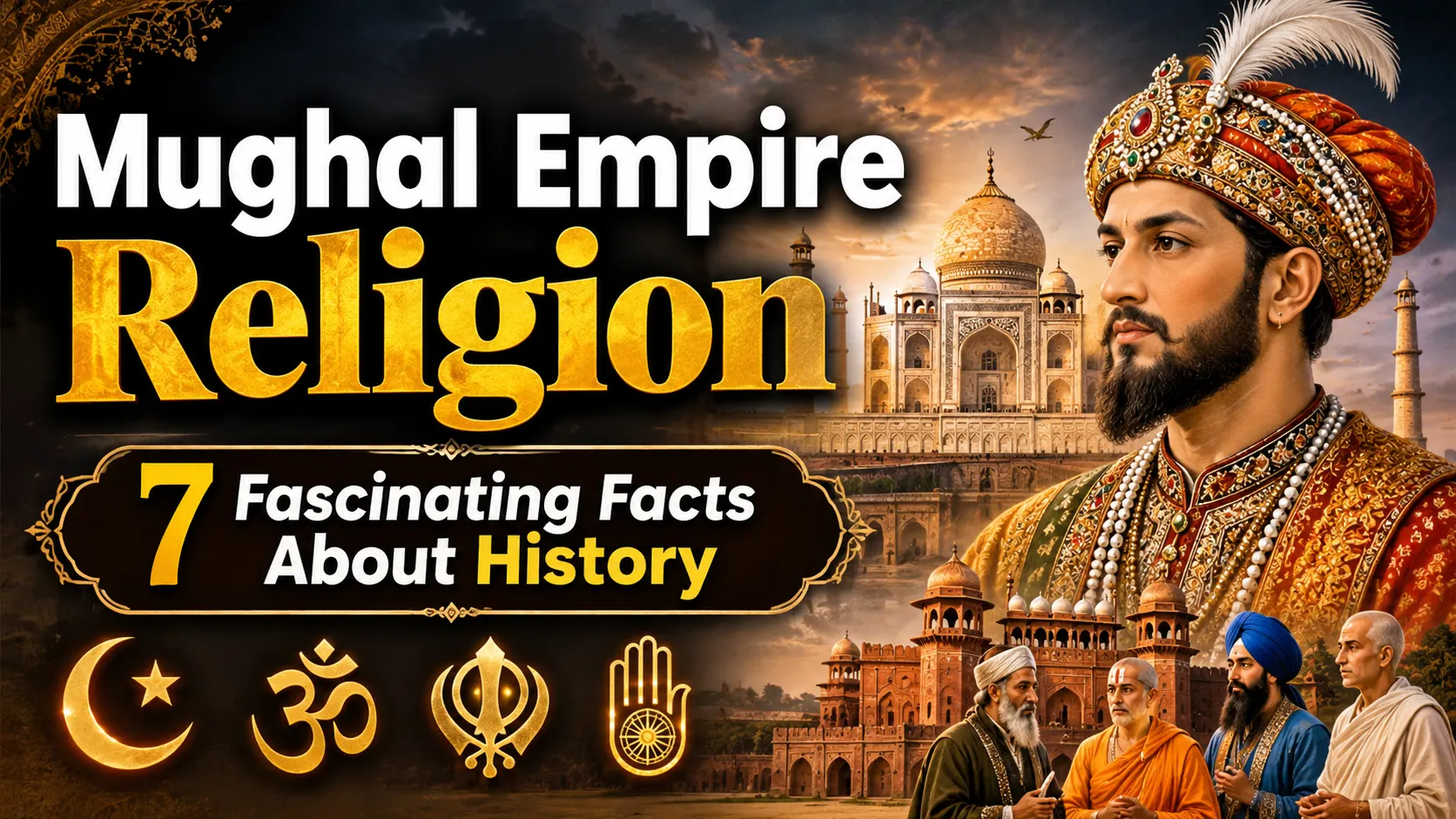
Mughal Empire Religion: History, Beliefs, and Religious Tolerance
Explore the religious beliefs, traditions, and policies of Mughal emperors and discover how religion shaped Mughal history, culture, and architecture.
Mughal Empire Religion: History, Beliefs, and Religious Tolerance
Explore the religious beliefs, traditions, and policies of Mughal emperors and discover how religion shaped Mughal history, culture, and architecture.
Mughal Empire Religion was crucial to the Mughal Empire’s history, culture, and governance. One of the strongest empires in Indian subcontinental history was the Mughal Empire. Babur’s victory over Ibrahim Lodi at the First Battle of Panipat in 1526 marked the beginning of it. Over the course of its more than three-century existence, the empire had an impact on religious customs, education, art, and architecture.
The Mughal emperors of the Mughal Empire practiced Islam. Nonetheless, residents of the kingdom practiced a variety of religions, such as Jainism, Islam, Sikhism, and Hinduism. Religious communities were treated differently by various Mughal kings. While some adhered to more stringent religious regulations, others encouraged religious tolerance.
Quick Overview
The Mughal Empire was founded in 1526 by Babur. Its rulers practiced Islam, while its population included followers of several religions. Akbar promoted religious tolerance, whereas Aurangzeb followed more conservative religious policies.
1. Islam in the Mughal Empire
Mughal Empire Religion, Islam played a significant role in Mughal royal life and governance. The early Mughal emperors promoted Islamic education, mosques, and religious experts in accordance with Islamic customs.
The Mughal Empire was founded by the Muslim emperor Babur. Even if their views on religion and governance were not always the same, his ancestors persisted in practicing Islam.
Muslim academics taught religious subjects in educational institutions throughout the Mughal era. Mosques were used for communal meetings and places of worship. Mughal architecture, literature, calligraphy, and imperial rituals were all impacted by Islamic traditions.
But Muslims were not the only people living in the empire. The Mughals ruled over millions of Hindus and followers of various faiths. Their customs and beliefs continued to play a significant role in society.
2. Religious Diversity in the Mughal Empire
Mughal Empire Religion, the religious and cultural diversity of the subcontinent was reflected in Mughal Empire religion. A significant portion of the population practiced Hinduism. While Sikhism and Jainism also had significant congregations, Islam was practiced by Muslims in various parts of the world.
People upheld their religious traditions, observed their own customs, and observed various holidays. Additionally, religious communities made contributions to administration, trade, agriculture, education, and the advancement of the arts.
Throughout the Mughal era, the interaction between these populations evolved. While some emperors implemented measures that caused conflict, others promoted harmony amongst religious groups.
Because of this diversity, religion was a significant concern for the Mughal emperors. They had to oversee a sizable people with diverse social traditions, customs, and beliefs.
3. Akbar’s Religious Tolerance
Mughal Empire Religion, Emperor Akbar, who ruled from 1556 to 1605, is renowned for his policy of religious tolerance. He thought that his dominion might be strengthened by collaboration between many communities.
In 1563, Akbar eliminated the pilgrimage tax, and in 1564, he eliminated the jizya levy on non-Muslims. Additionally, he established political partnerships with a number of Rajput kings. A few Rajput aristocrats were given prominent roles in the Mughal government.
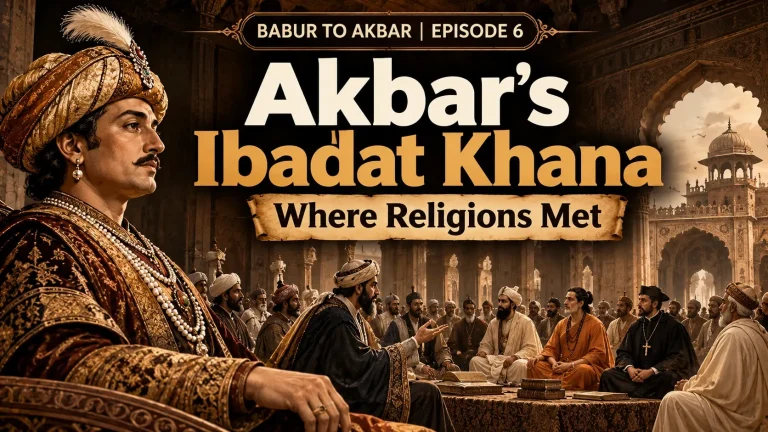
Akbar promoted dialogue between adherents of many faiths. He founded the Ibadat Khana at Fatehpur Sikri, where religious experts exchanged ideas and beliefs.
Did You Know?
Akbar promoted the principle of Sulh-i-Kul, meaning universal peace. It emphasized peaceful relations among different religious communities.
Akbar was able to establish connections with various communities throughout the empire because to his religious initiatives. His strategy turned into one of the most famous instances of Mughal religious accommodation.
4. Din-i Ilahi and Akbar’s Religious Ideas
Mughal Empire Religion, Din-i Ilahi, a minor religious and moral movement connected to Akbar in the late sixteenth century, is also connected to Mughal Empire religion. Although it was not a well-established religion with a sizable following, it is occasionally referred to as a new religion.
Through conversations with academics and his fascination with other religious traditions, Akbar evolved his beliefs. The movement placed a strong emphasis on loyalty, moral behaviour, and a few spiritual tenets.
Just a few people signed up for it. The majority of individuals in the Mughal Empire persisted in practicing their pre-existing faiths.
Din-i Ilahi demonstrates Akbar’s curiosity about religious concepts and promoting interfaith understanding. It did not, however, supplant other well-established religions in the empire, such as Islam or Hinduism.
5. Jahangir and Shah Jahan’s Religious Policies
Mughal Empire Religion, Jahangir ruled the Mughal Empire from 1605 to 1627. Both cooperation and confrontation were part of his religious policies. Although he carried on a number of customs that had been established during Akbar’s rule, he occasionally had tense relations with particular religious groups.
The Sikh Guru Arjan was put to death in 1606 during the reign of Jahangir. This incident turned into a significant turning point in Mughal-Sikh ties history.
From 1628 until 1658, Shah Jahan was in power. He is well-known for constructing the Jama Masjid, the Taj Mahal, and other significant structures. Islamic architecture and regal customs are closely linked to his reign.
In several ways, Shah Jahan’s religious policies were more traditional than Akbar’s. Nonetheless, non-Muslims continued to participate in many facets of society and government, and people from other religious backgrounds continued to reside in the empire.
6. Aurangzeb and Religion
Mughal Empire Religion, from 1658 until 1707, Aurangzeb was in power. Compared to some of his predecessors, he adhered to a more traditional view of Sunni Islam.
Aurangzeb reinstated the jizya tax on non-Muslims in 1679. Restrictions on specific religious practices and the destruction of some temples were also part of his reign, though the specifics varied depending on the region and political climate.
Many Hindu officials, including powerful lords and military leaders, were employed by his government at the same time. Religious convictions, political choices, local disputes, and the difficulties of managing a sizable empire all influenced his actions.
The religious policies of Aurangzeb are still up for historical discussion. Relationships between the Mughal government and various religious communities were impacted by his rule.
In order to comprehend this era, one must examine both the empire’s broader political circumstances and its religious policies.
7. Religion and Mughal Art and Architecture
Mughal Empire Religion, Mughal art and architecture were greatly impacted by religion. Mosques, tombs, gardens, forts, and other buildings that showcased Islamic customs and Persian artistic influences were constructed by Mughal emperors.
One of the most well-known examples of Mughal architecture is the Taj Mahal in Agra. Constructed by Shah Jahan as a tribute to his wife Mumtaz Mahal, it boasts a magnificent marble construction, geometric designs, and exquisite calligraphy.
Another significant example of Islamic architecture is the Jama Masjid in Delhi, which was built during the Mughal era. Constructed during the era of Shah Jahan, it continues to be an important historical landmark.
Indian customs were also included into Mughal art. This combination produced a unique artistic style that had an impact on ornamental arts, architecture, painting, and garden design throughout the subcontinent.
These monuments demonstrate how religion, culture, and royal power were connected during the Mughal period. You can learn more about the Taj Mahal from the UNESCO World Heritage Centre.
8. The Impact of Religion on Mughal Society
Mughal Empire Religion, throughout the Mughal Empire, religion had an impact on social interactions, education, festivals, family customs, and governmental policy.
Religious organisations promoted community life and offered education. Intellectual and cultural advancement was aided by academics, poets, artists, and religious leaders.
Religious communities did not always get along. Tensions occasionally resulted from disagreements, royal decisions, taxes, and political disputes. But the administration and economy of the empire also heavily relied on intergroup collaboration.
Depending on the monarch, the area, and the historical context, religious communities had different experiences. As a result, no single policy or emperor’s choices can adequately explain Mughal religious history.
Conclusion
The history, culture, politics, and architecture of the Mughal Empire were significantly impacted by religion. The Mughal emperors practiced Islam, yet the empire was home to a diverse population.
While Aurangzeb pursued more strict religious policies, Akbar gained notoriety for promoting religious tolerance. The connection between religion and government was also influenced differently by Jahangir and Shah Jahan.
South Asian history was profoundly impacted by the Mughal Empire. Historians and tourists are still drawn to its monuments, artistic customs, and intricate religious ties. Understanding the significance of cultural diversity, political power, and religious beliefs in forming societies is made easier by studying Mughal religious history.
Explore More History
Discover more about historical empires, ancient cities, and the cultures that shaped our world by exploring related articles on this website.