Roman Empire Timeline: The Rise Golden Age, and Fall of One of History’s Greatest Empires.
ANCIENT HISTORY
Roman Empire Timeline: The Rise, Golden Age, and Fall of One of History’s Greatest Empires
Discover the history of Rome, its powerful emperors, golden age, and eventual fall.
The Roman Empire Timeline is one of the most fascinating journeys through ancient history. From a small settlement in Italy to one of the most powerful empires in the world, Rome shaped politics, architecture, law, culture, and civilization for centuries. Its history includes legendary emperors, remarkable battles, economic growth, and the eventual fall of an empire that once ruled vast territories. Understanding the Roman Empire Timeline helps us explore how Rome became a global superpower, reached its golden age, and eventually declined.
Roman Empire at a Glance
753 BC: Founding of Rome
509 BC: Beginning of the Roman Republic
27 BC: Beginning of the Roman Empire
117 AD: Greatest territorial extent
476 AD: Fall of Western Rome
1453 AD: Fall of Constantinople
1. The Founding of Rome (753 BC)
According to Roman mythology, Rome was founded in 753 BC by twin brothers Romulus and Remus. Legend says they were raised by a female wolf before Romulus established the city and became its first king. Although historians debate the legendary story, archaeological evidence confirms that early settlements existed in the area around the 8th century BC. Rome initially developed as a small community but gradually expanded its influence through military strength, trade, and political organization.
2. The Roman Kingdom (753–509 BC)
Roman empire timeline, The Roman Kingdom was the earliest period in Roman history. During this time, Rome was governed by kings who controlled military, religious, and political affairs. According to traditional Roman accounts, seven kings ruled during this period. The last king, Tarquinius Superbus, was overthrown because of his unpopular leadership. His removal marked the beginning of a new political system and an important turning point in the Roman Empire Timeline.
3. The Roman Republic (509–27 BC)
Roman empire timeline, In 509 BC, Rome established the Roman Republic after removing its monarchy. Instead of having a king, Rome introduced a government system in which elected officials, senators, and assemblies shared political responsibilities. The Roman Republic expanded through military campaigns and conquered territories across Italy, North Africa, Greece, and parts of the Mediterranean. One of the most significant events was the Punic Wars against Carthage. These conflicts helped Rome become the dominant power in the western Mediterranean. However, political corruption, economic inequality, and civil wars weakened the Republic. Julius Caesar became one of the most influential leaders during this period. In 44 BC, he was assassinated by Roman senators who feared his growing power.
4. The Beginning of the Roman Empire (27 BC)
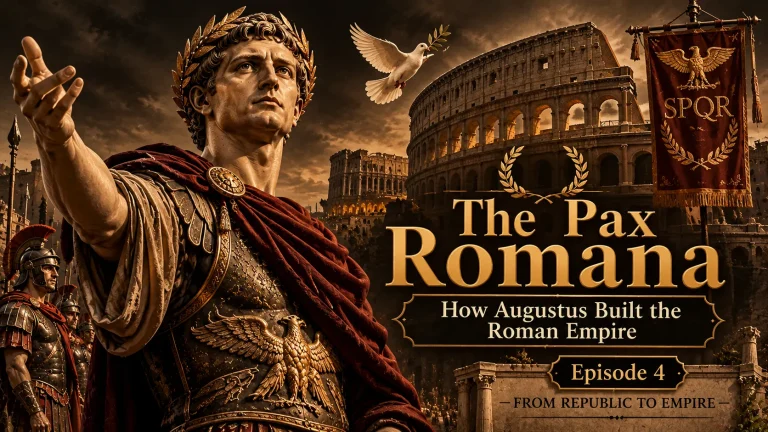
Roman empire Timeline, The Roman Empire officially began in 27 BC when Octavian received the title Augustus from the Roman Senate. Augustus became Rome’s first emperor and introduced major political, economic, and military reforms. His leadership brought stability after years of civil war. This period marked the beginning of the Pax Romana, a long era of relative peace and prosperity. The Roman Empire continued expanding, strengthening its administration, developing infrastructure, and establishing its influence across Europe, North Africa, and the Middle East.
5. The Pax Romana: Rome’s Golden Age (27 BC–180 AD)
Roman empire timeline, The Pax Romana, meaning “Roman Peace,” was one of the greatest periods in the Roman Empire Timeline. Lasting approximately 200 years, this era brought political stability, economic growth, and cultural development. During this period, several important emperors ruled Rome, including Augustus, Trajan, and Hadrian. The empire reached its greatest territorial extent under Emperor Trajan around 117 AD. Romans constructed roads, bridges, aqueducts, amphitheaters, and public buildings. Roman law, engineering, literature, and architecture also developed significantly. The famous Colosseum in Rome became a symbol of Roman engineering and entertainment.
6. The Crisis of the Third Century (235–284 AD)
After the death of Emperor Severus Alexander in 235 AD, Rome entered a period of severe instability known as the Crisis of the Third Century. The empire experienced frequent changes in leadership, military rebellions, economic problems, inflation, and invasions by foreign groups. During this period, several emperors ruled for short periods before being overthrown or assassinated. The empire also faced challenges from the Persian Empire and Germanic tribes. These problems weakened Roman authority and threatened the survival of the empire.
7. The Reforms of Diocletian and Constantine (284–337 AD)
Emperor Diocletian came to power in 284 AD and introduced major reforms to restore stability. One of his most important decisions was dividing the empire into administrative regions through a system known as the Tetrarchy. Later, Emperor Constantine introduced important political and religious changes. In 313 AD, the Edict of Milan granted religious toleration to Christians throughout the empire. Constantine also established Constantinople as a new imperial capital in 330 AD. This city later became the center of the Eastern Roman Empire.
8. The Fall of the Western Roman Empire (476 AD)
The Western Roman Empire gradually weakened because of political instability, economic difficulties, military pressure, and repeated invasions. Germanic groups entered Roman territories, making it increasingly difficult for Roman emperors to maintain control. In 476 AD, the Germanic leader Odoacer removed the last western emperor, Romulus Augustulus, from power. This event is traditionally recognized as the fall of the Western Roman Empire. However, the Eastern Roman Empire continued to exist for nearly another thousand years.
9. The Byzantine Empire (330–1453 AD)
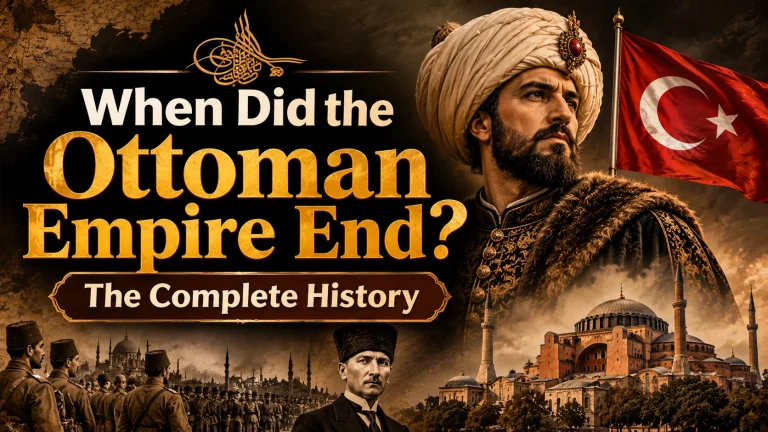
After the fall of the Western Roman Empire, the Eastern Roman Empire continued under the name Byzantine Empire. Its capital, Constantinople, became an important center of trade, religion, politics, and culture. The Byzantine Empire preserved many Roman traditions, laws, and institutions. It survived for centuries until 1453 AD, when the Ottoman Empire conquered Constantinople under Sultan Mehmed II. This event marked the end of the Eastern Roman Empire and brought the Roman imperial tradition to a close.
Conclusion: Why the Roman Empire Timeline Still Matters
The Roman Empire Timeline represents one of the most remarkable stories in world history. From the founding of Rome in 753 BC to the fall of Constantinople in 1453 AD, Roman civilization influenced generations through its laws, architecture, government, language, and engineering. Although the Roman Empire eventually disappeared, its legacy continues to influence modern society. Many political systems, legal traditions, architectural designs, and cultural institutions still reflect Roman achievements. Studying the Roman Empire Timeline allows us to understand not only the rise and fall of a powerful civilization but also the lessons of leadership, expansion, innovation, and political change.
THE LEGACY OF ROME • ANCIENT HISTORY