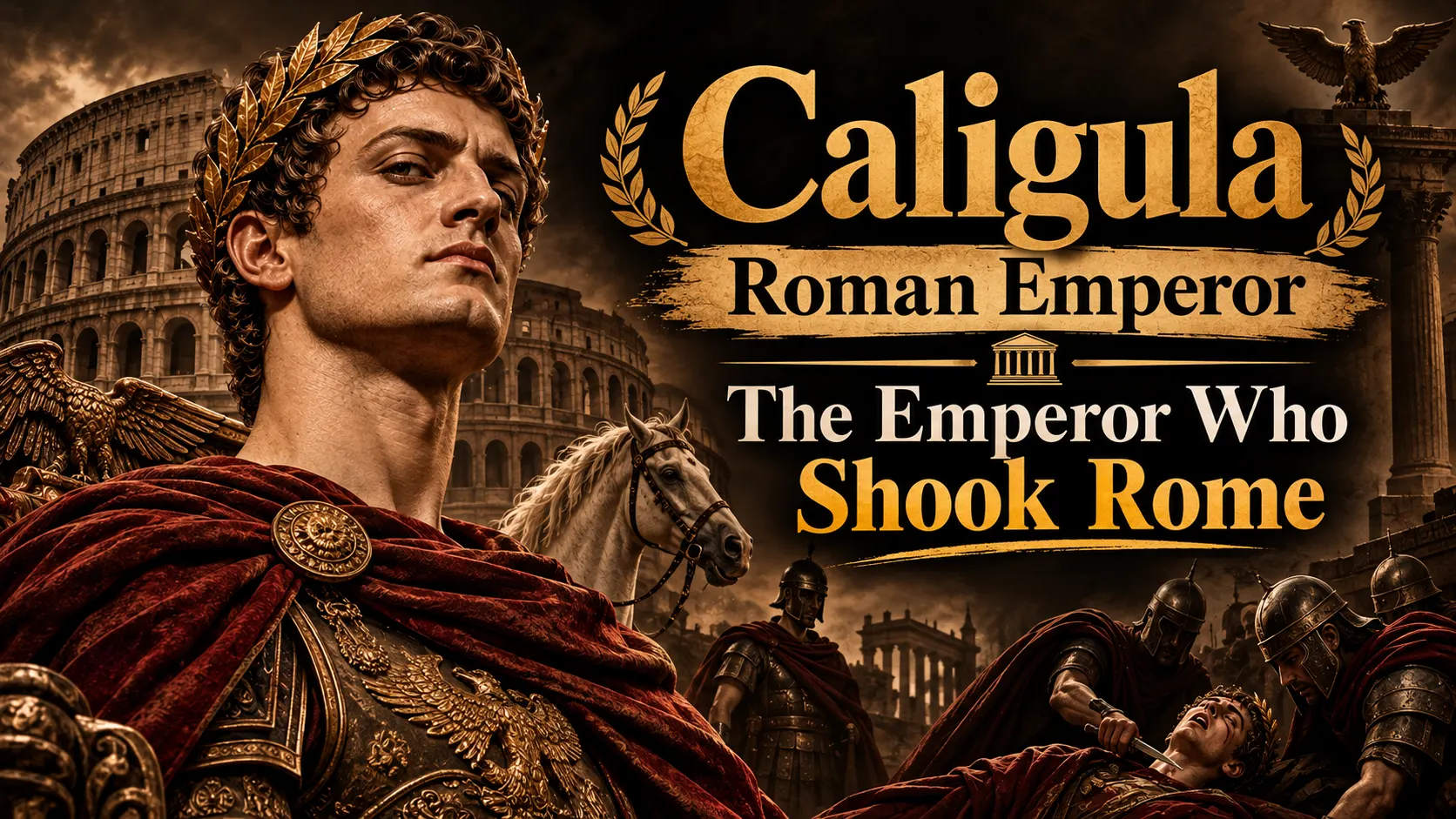
Caligula Roman Emperor: The Emperor Who Shook Rome
Introduction
Caligula roman emperor, One of the most contentious periods in ancient Roman history is the tale of Caligula, the Roman Emperor. Rome welcomed a new emperor who was supposed to usher in a new era following Tiberius’s death in AD 37. Caligula belonged to the esteemed Germanicus family and was young and well-liked. People initially thought he would be a terrific ruler. But his rule quickly became a tale of political unrest, terror, excess, and treachery. The youthful emperor who had once won Rome’s affection would go on to become one of its most notorious leaders.
The Rise of Caligula: A New Hope for Rome
Caligula roman emperor, In AD 37, Caligula—real name Gaius Julius Caesar Augustus Germanicus—became emperor. His moniker, Caligula, which translates to “little boots,” originated from the tiny military shoes he wore when growing up and travelling on military expeditions with his father, Germanicus.
Many Romans rejoiced when he was crowned emperor. They thought his son would govern more effectively than Tiberius since they remembered his father as a well-respected general.
Caligula displayed acts of generosity in his early months. He organised public festivities, invited back those who had been banished, and portrayed himself as a leader who was concerned about the Roman populace.
A Sudden Change in Leadership
But the bright start was short-lived. Following his severe illness in AD 37, Caligula’s conduct drastically changed, according to ancient historians. The precise motivations for his subsequent behaviour are still up for discussion.
His relationship with the Senate grew more challenging as his tenure went on. He regarded political conflicts with increasing animosity and demanded that his authority be acknowledged more.
Financial strain was also brought on by his lavish spending. Ambitious undertakings, lavish games, and public festivities became significant aspects of his reign. Caligula – World History Encyclopedia
Caligula Roman Emperor and His Controversial Decisions
Caligula roman emperor, Caligula gained notoriety for tales that startled Roman culture. He was charged by ancient authors with extreme conduct, needless cruelty, and dehumanising influential senators.
According to a well-known tale, he desired to make Incitatus, his favourite horse, a consul. Despite the fact that this tale is frequently recounted, historians wonder if it was a fabrication intended to disparage him or if it truly occurred.
His rapport with the Senate kept getting worse. Members of the imperial court started to worry more and more about their positions, and many senators feared his erratic actions.
His reputation suffered as a result of these incidents, and mistrust spread across Rome.
The Growing Opposition Against Caligula
Caligula roman emperor, Opposition grew within the Praetorian Guard and the imperial administration as Caligula’s reign became more contentious.
The emperor’s actions and political choices alienated influential Roman leaders. Eventually, some of the Praetorian Guard, who were meant to defend the emperor, joined a plot against him.
In contrast to previous political disputes, this opposition would abruptly and violently end his rule.
Caligula’s Assassination in AD 41
Members of the Praetorian Guard and other conspirators killed Caligula on January 24, AD 41.
His brief four-year reign came to an abrupt end with his death, which stunned Rome. The conspirators’ intentions to reinstate the Republic were unsuccessful.
Rather, the Praetorian Guard backed Claudius, Caligula’s uncle, who went on to become the next Roman emperor.
Rome had transcended the previous Republican political structure, as evidenced by the imperial system’s resuscitation.
Conclusion
Caligula roman emperor, Caligula’s reign served as a warning about the perilous nature of unbridled imperial power. His connection with Rome’s influential institutions was ruined by political disputes, contentious choices, and mounting resistance, despite the fact that he started his reign with popular support and high expectations.
Another chapter in the history of the Roman Empire began with his assassination in AD 41. Restoring stability and demonstrating that Rome could withstand another challenging handover of power were now Claudius’s challenges.
However, how would Claudius alter the course of the Roman Empire and who was he?
Discover the next phase of ancient Rome by continuing the From Republic to Empire series.
Next episode coming on
All episodes of From Republic to Empire
-
1
 Crossing the Rubicon
1 min read
January 49 BC: a general reaches a small river and makes a choice there is no coming back from.
-
2
The Ides of March
1 min read
15 March 44 BC: the dictator for life walks into a meeting of the Senate.
-
3
Augustus, the First Emperor
1 min read
He never called himself king, yet he ruled Rome for forty years.
-
4
 Episode 4: The Pax Romana — How Augustus Built the Roman Empire
3 min read
-
5
 Episode 5:Tiberius Roman Emperor: The Dark Side of Power in Ancient Rome
5 min read
-
6
 Episode 6: Caligula Roman Emperor: The Emperor Who Shook Rome
4 min read